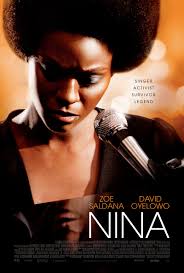
Nina Simone (1933-2003) was an American jazz singer/ songwriter/ classical pianist and social activist whose musical genius helped to shape the genre of soul music of her time. She was born Eunice Kathleen Waymonto John Divine and Mary Kate Waymon in Tryon, North Carolina. The daughter of Christian Ministers, Eunice's musical talent was groomed from an early age. It was Englishwoman Muriel Mazzanovich who moved into Eunice's town, that taught her in the classical arts. She then went on to graduate at the top of her high school class and began her studies at Julliard in New York City on a scholarship grant awarded by her community(c. She thereafter applied to the prestigious Curtis Institute of Music where she was denied admission, which she cites as an act of racism. A music teacher by day Eunice supplemented her earnings by singing in bars and this is where she created the sobriquet "Nina Simone", in order to hide her night time activities from her strict Christian parents.Nina was discovered at the age of 24 and signed to Bethlehem Records and then to Coplix Records, a division of Colombia Pictures. She rose to fame in the 1960's music arena especially appealing to a night club based audience. Her music lives on today and her contribution to the industry is undeniable.This year the movie was released for video on demand by RLJ Entertainment. The Nina movie which focused on her career as a musician and her peculiar relationship with her manager Clifton Henderson (David Oyelowo). In the months leading up to the movie's release there was a public outcry from Nina's estate that the lead actress Zoe Saldana bore no resemblance to their high priestess of soul.
Niana Simone
Zoe Saldana
Now I must admit that prior to the controversy I knew very little about the late Ms Simone or rather I thought I knew very little because an internet search on the famous jazz musician revealed that I had in fact heard some of her music such as the powerful gospel inspired "Sinnerman"; "Feeling Good" which is often featured in current films; as well as her 1957 remake of Nate King Cole, Count Basie and Woody Herman's "My Baby Just Cares for Me". All the while ignorant of the very much acclaimed singer/ musician. At first I was skeptical of Zoe's ability to recreate the natural vibe of the American music legend but the movie stands as a testament to Ms Saldana's acting qualities and her own admiration for the legend. While the apparent differences may justify the casting of another actress as the lead role, Zoe's portrayal of Nina overshadows any questions about her lack of the resemblance to the late singer. Ms Saldana's dedication to the character is even praised by her costar David Oyelowo who reveals that he was blown away by Zoe's singing in the movie. Zoe loses herself in Nina and even manages to capture some of the late singer's nuances as she belts out some of Simone's hit singles for the movie Nina. Oyelowo further informs that Simone's former guitarist Al Shackman says that the singer would have loved that her story was told especially from the point of view of love, because she was a "big lover of love."
I hope you get a chance to catch the Nina Simone biopic. It is a great story of a legend and Zoe Saldana's portrayal is indisputable. Leave us a comment below and tell us what you think
The Haunting(1963) is the first of the two film adaptions of the Shirley Jackson novel The Haunting of Hill House. Directed by
Robert Wise for Metro-Goldwyn-Mayer Studios, The Hunting was first released in
August 1963 starring Julie Harris (Eleanor Lance); Claire Bloom (Theodora);
Richard Johnson (Dr John Markway) and Russ Tamblyn (Luke Sanderson). Despite
bearing slight modifications from the original plot, it remains the most
faithful adaptation of Shirley Jackson’s novel to date and is praised by movie
critics as one of the scariest horror films of all times. Robert Wise’s
interpretation of Jackson’s psychological ghost story does not take away from
the author’s intent but provokes the same sense of inescapable terror.
The theme of perverted love appears variably
in The Haunting of Hill House but is
one that is considerably established in film. In the film Robert Wise
expounds upon this forbidden- type love and in some aspects more accentuated
than in Jackson’s novel. Theodora’s submission that Eleanor is trying to “attract
attention”, although originally said in a concerned attempt to distract an
agitated Eleanor, exemplifies the fact that at Hill House she has become
somewhat the centre of attention. All assumed affections of love are projected
towards, as well as reciprocated by her. Hill House is also implied to have selected
of Eleanor; even calling her by name with the inscriptions “Help Eleanor Come
Home”. Eleanor’s encounter with the house seems to characterize a destined
meeting of “kindred spirits”. Standing outside Hill House she thinks “it’s
waiting for me. Evil, patient… waiting”; she soon afterwards, as Dr Markway
puts it, falls “under the spell of the house” eventually submitting to what she
believes are its wishes: “I’ll come… I’ll come, whatever it wants of me it can
have”. Another replication of Jackson’s concept of contrived love is aired
through Theodora’s advances towards Eleanor which coupled with the ambiguity of
Theodora’s own sexual orientation, raises the tabooed subject of homosexuality.
Wise’s only deviation but which still maintains the theme, is his exaggeration of
the fondness between the married Dr Markway and Eleanor. For Eleanor knowing
that she is “cherished” by the Doctor is as important as finding her place at
Hill House.
Eleanor’s desperate search for acceptance
strongly involves her feelings of loneliness and the need to belong. These are
especially emphasized in the movie through her obsession with having a home of
her own (“someday... someday, I’ll have an apartment of my own”). Having her
own home represents for her a place where she belongs and where she can be “a
new person”. Being expected at Hill House and being a part of the team gives
her the satisfaction of sharing in something “truly extraordinary” as she
determines “at last I’m going someplace where I’m expected and where I’d be
given shelter…". Her greatest fear
is of being left alone; the strange happenings at Hill House itself do not
disturb her as much as this, which she asserts to Dr Markway and Theodora:
“I’ve always been more afraid of being left alone or left out than of things
that go bump in the night”. The bizarre occurrences in The
Haunting raise questions of trauma induced psychosis against supernatural
manifestations. It is sometimes unclear if the incidences at Hill House are as
a result of paranormal activities or the designs of an unstable mind. In a
Journal Article for Mental Health Practice on the relationship between
Post-Traumatic Stress Disorder and Psychosis the author stresses “There are
similarities between the intrusive thoughts, images, and flashbacks that are
commonly associated with PTSD and the hallucinations and delusions associated
with psychosis.” This prognosis is
paralleled at Hill House where a history of traumatic experiences precede
psychotic- like behaviours.
Borrowing from The Haunting of Hill House’s deduction
of its ghostly manor “in its true personality” Wise traces Hill House’s “evil
reputation” to the ill-fated alliance of old Abigail Crain and her paid
companion. Blamed for the death of her benefactor the companion is believed to
have been driven mad and eventually committing suicide by “whatever there was
and still is in the house”. Less than ninety years later, Eleanor Lance is
shown to have suffered a similar fate. Dr Markway says “Fear alone can do the
damage to the victim”; which makes a convincing appeal for any suggestion that
what is actually happening to Eleanor is her mind’s way of dealing with her
traumatic experiences. Being the sole caretaker of a sick and overbearing
mother causes Eleanor to feel “walled up” and robbed of her adult life. When
her mother dies Eleanor is left with a self- loathing guilt that she is somehow
responsible. A clearly troubled Eleanor is now predisposed to abnormal
behaviours and the rumoured haunted Hill House provides the ideal outlet.
Even at the end, Eleanor’s belief that Hill
House wants her still remains dubious since there is an air of uncertainty
surrounding some of her paranormal evidences. Her initial misgivings about Hill
House in thinking of it as “vile” and a monster ready to swallow her whole soon causes her to exhibit paranoid behaviours, such as her firm belief that she is being pursued by the house. Also, her
episode in which she is left wondering “Whose hand was I holding?” leaves
similar doubts in the viewer’s mind and incidentally her own, about what is
actually taking place. It is not known if it was really an act of the
supernatural or if it was Eleanor’s mind reconstructing a previous event.
Eleanor’s agitated mannerism
and defensiveness are further signs of paranoia. Due to uncontrollable guilt,
she is wary of any questions pertaining to her mother. Sometimes thinking that
everyone is against her she lashes out at Theo (Am I the public dump or
something for everybody's fear?). The arrival of Mrs Markway at Hill House
further adds to her sense of distress, as in her mind she has created somewhat
of a family setting with her fellow housemates (These people are my friends.
I'm one of them. I belong) and Grace’s presence poses a threat to her rightful
place at Hill House (I'm the one who's supposed to stay here. She's taken my
place).
In addition to possibly
possessing delusional beliefs, at times the nature of Eleanor’s involvement at
Hill House can be credited to hallucinations. Most of what is learned about
Eleanor’s personality is revealed through her inner thoughts, which to a great
extent appears weakened. Eleanor seems to be an occupant of both Hill House and
her own mind, and the physical confusion going on in the house mirrors her own
mental confusion. Another incident which can be attributed to hallucinatory
manifestations takes place when Eleanor is repulsed by a certain smell at Hill
House’s library. Bearing that she alone can discern this “awful” smell, once
again brings into disrepute her claims of the supernatural which is even
challenged by her co- occupants (“Is this one of your crazy hallucinations?”)
The first of the two
film adaptions of Shirley Jackson’s novel, The Haunting (1963) directed
by Robert Wise's The Haunting is praised both for its faithfulness to its literary predecessor and as
one of the scariest horror films of all times. If you are into the oldies, The Haunting is a great recommend. Take a look at let us know what you think by leaving a comment below.
Shaun Escayg's directorial debut, “Fish”won “Best short Film” at the Belize International Film
Festival and “Best International Film” at the Malibu International Film
Festival. “Fish” was also an official selection at the 2012 Los Angles International
Short Film Festival(LA Shorts Fest), an Academy qualifying film festival.
FISH
Screened at the 2012 Trinidad
and Tobago Film Festival, short films Fish
by Trinidadian born director Shaun Escayg deal with social
challenges within the region. Shot in Trinidad and Tobago, Fish’s main characters Fish (Marc Escayg)
and Sticky (Carlos Quashie Jr.) are both unemployed youths who loiter at the central
market, picking the pockets of unsuspecting shoppers. Upon his return from a
robbery, Fish sees Puppet (Fabrice Barker), an associate of the underworld
being arrested, and steals a wad of cash from within his (Puppet’s) car. This
decision then leads to them being captured, tortured and the death of Sticky at
the hands of the Surgeon (Anthony Lawrence) the main drug lord. Escayg communicates strong messages through his short film as he does not share a
picture of the scenic islands of the Caribbean but instead produces a region adversely
affected by social challenges.
In highlighting the
social concerns of the island, Escayg's film extracts its subjects from the
socially marginalized. The lead characters are severely
impoverished and have adapted to a life of thievery in order to survive. Fish
and Sticky reside in an abandoned boat house by a bay and with no money for food,
Fish and Sticky’s only meal, after their market robbery failed to produce, was
a pommecythere. The director further uses the
contrasting shots of the city, existing oblivious to those on the margins, to
further impress his characters’ deprived state.The actors all manage
to represent the anguish of the underprivileged. Their frustration is detailed
in the surrendered demeanour of the main characters, whose only concern is
survival by any means necessary. Their choices are not only triggered by greed but by their
desperation and need to survive. Like Sticky says to Fish their goal is “trying
to make sure they [we] eat.” While portraying
characters who are involved in criminal activities, the director deals fairly
with them by giving a glimpse into the story behind their illicit lifestyle. From
the conversation between Fish and Sticky as they sit in repose after evading police officials at the market, the viewer is able to determine how these youths
fell into a life of crime. He does this to prove that even those on the brinks of
society do dream of a better life. In such instances the otherwise perceived
lawless figures are humanized as their stories prove how easy it is to get
involved with crime. Fish makes a solid
statement on the hardships of life on the island of Trinidad which lead to the
characters’ current state. In dealing with the problem
of crime on the island, Escayg gives viewers the reality of
the detrimental inevitability these choices. He represents the ripple effects
of being involved in criminal activities. As voiced by the character Fish who
by way of his decision to steal from Surgeon, becomes responsible for the death
of his cousin Sticky: “when you kill somebody, the devil own your soul… you
does spend your whole life trying to buy it back.” Here the director articulates
the unending perils of being a part of the underworld.In unfolding the
complexities of the criminal world, director Shaun Escayg's films also seem
to make the assessment that there are persons who are caught up in minor infringements
who pay the greater consequence. The film portrays the chain of command
operating within the underworld and those who exist there are aware of who
is in change. When Surgeon questions his captives about his stolen cash, beaten
and tortured, Sticky cries “We not that stupid”.
Keeping with this chain of command, in the end it’s the
least harmful are the ones who suffer the most. Although Fish and Sticky are shown as part of the crime problem in the island, their
actions pose no dire threat to their victims. While the ones perpetrate the
more heinous crimes continue to negatively affect their communities.
Also noted is the
inability of the law officials to control the crime situation.
This is especially dealt with in Fish, where
the protagonists are able to skilfully evade the security at the market. Puppet even boastfully declares to the arresting corporal that “in one hour, I back outside” furthermore,
hinting to the law’s lack of power. Most telling of this ineffectiveness occurs
while Puppet is being arrested; Fish manages to steal money from within his
car, unbeknownst to the corporals.
In less than 15 minutes Shaun Escayg discusses elements of
the criminal underworld in the Caribbean of Trinidad. He does not share a picture of the scenic
islands of the Caribbean but instead display a region affected by social
challenges.
Horror films are not my thing. Actually I'm not at all a fan of the head spinning, eyes turned inward, gorey, Gothic film category but Alfred Hitchcock's thriller Psycho has managed to captivate even a squirmy movie goer like me. His bold, risk taking film, which helped to revise the movie codes of his time, can be said to be the template for many horror films which followed.
PSYCHO
Starring Anthony Perkins, Janet Leigh and Vera Miles.
In the 1960 thriller Psycho, director
Alfred Hitchcock examines the different dimensions of the human psyche. The
film’s central plot develops at the Bates Motel 15 miles off Fairvale,
California where a young secretary Marion Crane (Janet Leigh) takes shelter
from a rain storm, after having stolen $40, 000 from her employer’s client. Following
on psychoanalytical theories developed by Austrian Physician Sigmund Freud
(1856-1939), Hitchcock shakes up the perception of the quiet small town and leaves
his audience with a disquieted sense of what really goes on behind closed
doors. Although reportedly highly skeptical of its restorative claims,
Hitchcock’s directorial approach in Psycho
concentrates on Freud’s study of psychotherapy.
Considered the most Freudian of all Hitchcock’s films, Psycho opens with
a show of the theory that the unconscious is the place where unsatisfied
desires are stored. It begins with a shot of a slightly opened curtain-less window
of a hotel room in Phoenix, Arizona. Hitchcock directly hinting to the nature
of the unconscious mind uses this essentially intrusive view to foreshadow his
theme. Inside the hotel room securely hidden from the outside world, a man and
a woman are getting dressed after a sexual encounter. Behind these closed doors
is where they are both concealed from existing social taboos regarding pre-
marital sex. Also in this room barely visible to the eye, is where the young woman
Marion Crane elusively fulfills her longings to be with Sam as his wife.
Hitchcock later expounds upon Freud’s concept of the unconscious when
the audience is introduced to Norman Bates. Seemingly mild mannered at first
Norman is soon exposed as being unable to control the desires of his id. The
director similarly treats with Norman’s unconscious in the way he does
Marion’s; symbolizing both their surroundings as the containment of hidden wishes.
Much like his true desires are buried within his unconscious mind, the Bates
Motel, as noted by detective Arbogast which “looks like it’s hiding from the
world”; acts as a covering for Norman’s secret crimes.
As seen in the film some memories and desires are repressed by
unconscious forces due to their painful or unacceptable nature. Freud theorizes
that the blocking of these memories or desires may not be harmful to the
individual but is rather the mind’s way of guarding against unpleasant effects.
Marion Crane, the first character of Psycho
to be subjected to this idea of repression as she deals with the guilt of her
crime, suffers its symptoms.
Her subsequent anxious behaviourafter
being confronted by the police officer on her way to Fairvale is indicative of the
memory of her actions searching for a release or as Freud terms it a ‘return of
the repressed’. Furthermore her attempts to avoid detection by trading in her
car for another betray her guilt and she raises additional suspicion when she
is about to drive out of the used car lot forgetting her coat and luggage.
In Norman’s case the theme of repression is explored to a greater
extent. For instance, the psychoanalyst points out in the end in order to
understand Norman’s situation: “you have to go back ten yearsto the time when Norman
murdered his mother and her lover”. The severity of his actions triggers an
already disturbed Norman “to erase the crime, at least in his own mind” in
order to continue living. In trying to block this memory Norman is accordingly
subjected to its constant resurgence, only this time in different forms. Thus,
his words and way of conduct inform the audience that there is something else
which lies beneath his supposedly calm demeanor. In conversation with Marion
whatever he is trying to repress effects slips in his speech and he has trouble
pronouncing the word ‘falsity’.
Another illustration of the return of Norman’s
repressed thoughts occurs when he is being questioned by detective Arbogast. He
becomes more and more uncomfortable with Arbogast’s line of questioning,
manages to lose track of what he is trying to say and eventually fumbles
through a fragmented account concerning Marion’s disappearance.
Moreover, the concept of the return of the repressed is ideally
symbolized by Norman himself disguised in his mother’s dress; a physical
manifestation of the repressed (his mother) coming to the surface. Then in the
final scene the director also leaves the audience with its own reminder when
Marion’s buried car is excavated from its muddy grave; as if to note that what
is hidden will eventually come to light.
Psychoanalysis holds the position that the ego acts as the mediator
between the other two facets of the human psyche; giving precedence to logical
thinking and discernment. It also follows on the belief that if there is
conflict between the super ego and id, and the ego is hindered from exercising
its responsibilities; the result would be a breakdown in the functioning of the
human mind, sending the ego into defense mode. This idea is achieved in the
film through the bad judgments of both Marion Crane and Norman Bates. Similarly
succumbing to the desires of the id these two are compelled to commit reprehensible
crimes. Knowing that what she did offends social codes of conduct Marion’s ego
is thrown into defensive action. In continuing with her plans to run away to
Fairvale, imply that Marion believes that she is somehow justified in what she
is doing. She then tries to eradicate anything which connects to her life in
Arizona by trading in her car for another; which she probably reasons will allow
her to escape without being followed.
Norman on the other hand encapsulates the deeply conflicted ego which
consequentially deploys various coping mechanisms. After murdering his mother,
he loses all sense of self and completely outfitted in his mother’s clothes, he
deals with his wrongdoing by assuming the identity of his victim. Also
noticeable in his behaviour are acts of regression whereby he assimilates a child-
like deportment when scolded by his ‘mother’ for his attraction to Marion and
in a boyish way he confesses to Marion that she (his mother) only allows him to
do certain chores which she deems he “might be capable of doing.” Norman also
manages his internal conflicts by trying to project an air of normalcy, continuing
with his daily routine; dutifully changing bed linens, as he calls it “following
the formalities”, of a motel which remains invariably uninhabited, and filling
his time with his hobby; taxidermy.
Also evidenced in the film is the role of the super ego which regulates
the mind according to socially and culturally accepted rules. This idea is
clearly represented in the scene where Marion makes her way to Fairvale with
the stolen cash. Hitchcock symbolizes her prodding conscience in the form of
the policeman, a recognized figure of justice and authority, who constantly
watches her every move. In contrast, in Norman’s world there are no reflections
of the super ego at work as he has already suppressed the will to conform to
societal norms. When these two are placed before each other, Marion senses in Norman’s
deportment what she could become and allows the super ego to work for her, although
in the end is unfortunately robbed of the opportunity for redemption.
Perhaps the most significant illustration of psychoanalytical
considerations stems from Hitchcock’s use of the Oedipal Complex as a prime
explanation for his main character’s behaviour. In this case Norman’s repressed guilt is manifested
in an oedipal complex. His unnatural attachment to his mother even posthumously,
is exhibitive of his lack of sexual development and identity. Again as
explained by the psychiatrist both the death of Norman’s father when he was a
young boy and eventually living alone with his “clinging, demanding” mother,
causes him to become “dangerously disturbed”. Never having to fight for her
affections before Norman is unable to quell his unconscious desires towards his
mother and thus get past the phallic stage of his development. When she becomes
involves with another man Norman’s mind is not able to accept this idea and out
of jealousy he kills both his mother and her lover. Having had no father figure
to identify with, Norman develops an exaggerated reverence for his mother and
becomes dependent on her for his very survival. Even though she had been dead
for ten years, he recreates her being in his mind and brings her to life by
becoming her. Still operating from this phase in his adult life, he also seems
to be unaware of the strangeness of his affections for his mother as he says to
Marion “A boy's best friend is his mother" and "A son is a poor
substitute for a lover."
Psycho is hailed today as the harbinger of the horror movie genre. Alfred Hitchcock really pushed the envelope in Psycho, making it one of the greatest, if not the greatest horror film of all time.
At the 2016 Academy Awards Leonardo DiCaprio won
his first golden statuette in the Best Male Actor's category for his portrayal of
frontiersman Hugh Glass in the adventure thriller "The Revenant."
As UN Messenger of Peace and a committed environmental activist, in
his acceptance speech Mr. DiCaprio, while giving credit to those who
contributed to his success, managed to switch the audience's focus for bit on to
the topic of climate change. He says of filming The Revenant, that
it was "about man's relationship to the natural world." A sentiment which is compatible to statements made by the movie's director and co- writer Alejandro González Iñárritu who views the film in respect of America's capitalist economy. About The Revenant he remarks it is about “the way these mendeal with nature… Cutting trees – profit from it. Killing animals – profit from it."
Alejandro González Iñárritu
Adapted from a novel written by Michael Punke which recounts the campfire tale of a 1820's American fur trapper Hugh Glass, The Revenant shows how one man's will to survive overcomes human and natural adversities. While there are other areas of conflict within the film, my focus is on that of man vs nature. While on a fur trapping expedition the frontiersman is attacked by and almost fatally injured by a female bear in the American wilderness. His fellow huntsmen' s attempt to escape the pursuing Ree warriors is then frustrated by a brutally wounded Glass and an order was then given by Captain Andrew Henry (Domhnall Gleeson) that he be left behind in
the care of bridger (Will Poulter), Glass' son Hawk (Forrest Goodluck) and John
Fitzgerald (Tom Hardy), and warned to allow their comrade to die an honourable
death. In an act of defiance and betrayal Fitzgerald murders Hawk while a
weakened Glass looks on, unable to save his only son. The nearly dead Glass
drags his way through the forested wilderness battling nature in order to exact
revenge upon his son's killer.
Much is said about directorIñárritu's use of natural light for the entire film and having to shoot unbroken takes which resulted in cast and crew relocating in order to avoid unfavourable weather conditions. The director's keen portrayal of nature is further reflected in his use of traditional cinematography as opposed to computer generated imagery. It is even said that Iñárritu chose to manufacture an avalanche instead of relying upon CGI for a scene.
DiCaprio recognizes this film as having "environmental undertones" and should be seen as an impression of man's conflict and abuse and depletion of the earth's natural resources. As he ends his speech at the Oscars, his call is for the world to preserve the earth for the benefit of future generations and he pleads "let us not take this planet for granted."
The National Organization for Albinism and Hypopigmentation defines the condition of Albinism "an inherited genetic condition that reduces the amount of melanin pigment formed in the skin, hair and/or eyes. Albinism occurs in all racial and ethnic groups throughout the world."
Blanco was screened at the 2014 T&T Film Festival. It is a documentary about an Albino community in the Dominican Republic.
In his first feature-length film director Melvin Duran, Blanco documents the lives of six
albinos of differing ages in the Dominican Republic. During the Q&A
segment, Mr Duran revealed that the documentary is guided at humanizing the
albino community within his country. He portrays his group, not as shunned or
marginalized due to their distinctive features but rather as being revered for
their white skin and blond hair. The opening scene
begins with a family inclusive of an infant girl who is albino. This is then
followed by a family of five; similarly made up of persons of seemingly mixed
races. In this case there were two albino children of pre- teen age. The director’s
attention to the various age groups is meant to point to the average life expectancy of a
person with albinism in his native Dominican Republic. Persons with albinism do
not live well beyond their 40’s due to the lack of education about the harmful
effects of the sun; which results in many albinos contracting skin cancer and which the
leading cause of death within the albino community.
Throughout the film the director creates a
sense of normalcy for his main characters. From their happiness to hardships; each
scene involving persons with albinism did not seem unique to the albino
community and in fact, he succeeds in blurring the line, as the apparent
differences are lost to the viewer.
Blanco also
reminds the audience that in some instances children are deprived of their
childhoods. This is illustrated as one of Duran’s female protagonists
reminisces about being married at the age of fourteen to a man almost thirty
years her senior. While this fate may
not be exclusive to his focus group; Duran again exposes some of the precipitating
effects of albinism.
Albinism is a condition which is often misunderstood and affects many around the world. In the Dominican Republic film director Melvin Duran humanizes a community of Albinos in his country and lets the viewers into their world, as he attempts to prove that their differences are only skin deep. If you enjoyed this piece and you can get your hands on a copy of Blanco leave us a comment below about your views on albinism and Duran's featuring of the often misrepresented community. You can also look out for more local and regional films at this year's Film Festival which is happening from 15/09- 02/10/2016.
I first came across this Spike Lee film in my Film as Communications class. With the recent views on black representation in the media this movie came to mind. Spike Lee really packs decades of black stereotypes into just 2hrs 15mins and it is indeed an eyeopener into what we have for years been fed through mainstream media.
Are we being Bamboozled?
American film director Spike Lee's Bamboozled (2000), takes on the issue of race relations and the portrayal of African Americans in the media. Delivered as a satire within a satire, Lee addresses head- on any misconceptions which may arise due to the film's heavy content. During the opening sequence the main character Pierre Delacroix, played by Damon Wayans, explains satire as:
"A literary work in which human vice or folly is ridiculed or attacked scornfully.... The branch of literature that composes such work.... Irony, derision or caustic wit used to attack or expose folly, vice or stupidity."
In this way Lee intends to direct the
public’s interpretation of his piece. Through his revival of the 19th century
Minstrel show, Spike Lee unmasks racial subtexts within current media. In Bamboozled’s live
audience production, “Mantan: The New Millennium Minstrel Show”, Spike Lee
emphasizes the treatment by the American media of black America. He reuses
racial images which have circulated American programming over the years. Lee
packs a full assortment of historically prejudicial figures on the Minstrel
stage. The staging of the Minstrel show on a watermelon plantation
is significant to racial stereotypes predating the abolition of slavery.
The cultural association of the
watermelon patch and the African American has long had a derogatory
interpretation but there is a little known historical report which thoroughly
opposes this offensive ideal. The real story of the watermelon in black
history became perverted with damaging assignments of uncleanliness, laziness, childishness, and unwanted
public presence, by Southern whites who were not in favour of the abolition of
slavery.
Lee also mimics those subtle racial
interjections in the current media where, like the watermelon fixture; other
foods are used as an indicator to black culture. This is displayed in the scene
where Womack (Tommy Davidson) and Manray (Savion Glover) feast on among other
fast food offerings, the fried chicken, while Delacroix discusses his concept
for the Minstrel show.
Other stereotypical
re-creations are demonstrated by the performers of the Minstrel show. The
painted blackfaces of the main actors Mantan and Sleep ‘n Eat are
displayedalongside a supporting cast of
almost every racial caricature which has stained the African community, such as
the “Tom”, “Coon”, “Pickaninny”, “Rastus”, “Aunt Jemima” and the “Alabama Porch
Monkeys”. With these and other statements, such as the antique figures which
progressively line Delacroix’s office, the audience never forgets the
misrepresentation of black people in US mainstream media and which seem to now be
perpetuated by the black community.
Accordingly, the film
also suggests that there are modern day representations of these typecasts. Singling
out gangster rap as the contemporary form of transmission of racial imagery to
the masses, Spike Lee’s film makes the implicit comparison between the current
genre and the preceding performance tradition. In the same fashion blackface
entertainment was backed by white America over 100 years ago, Lee imitates the
appeal of gangsta rap, a brand of music known for its sexually explicit content
and which boasts its evolution within the black community. The main objective of the movie was to communicate how Black Americans are perceived by their counterparts. The director shows that throughout history blacks have been appropriated subjugated roles which are meant to demean and propagate black inferiority. Lee's film also acknowledges that the American public is uncomfortable with the projection of "the middle class black family"; as reasoned by Dunwitty who explains to Delacroix why his previous pilots were failures; he says "wake up, brother man. The reason why they didn't get picked up was because nobody- and I mean NOBODY- niggers and crackers alike wants to see that junk."
In addition to examining how the black community is regarded by white America, Bamboozled observes how African Americans see themselves. The director probes the idea that most blacks operate with a double consciousness where in order to be accepted they assimilate an identity closer to that of those who assume superiority, only to reclaim a sense of culture when among others of their group. He satirizes this with the Mau Maus and Delacroix as both groups excessively exalt their side of the dichotomy. The Mau Maus’ Afrocentric philosophy is in direct contrast to Delacroix’s Harvard educated disposition and which least fits the image of a person of his race.
Along with highlighting that white America has for years gained power and controlled the perception of the black community, Bamboozled explores the view that the powerful seem to believe that they have the authority to determine what is offensive. The flagrant use of the word “nigger” in television for instance is their way of trying to placate its offensive origin and is being justified by the idea “Nigger is just a word.” Spike Lee in turn gives reasons for the roles given to African Americans in television as the movie demonstrates that even 100 years later, white America power structure, as represented by Dunwitty and CNS executives, still have controlling power over the entertainment industry and therefore, determine its content.
The movie ends with a montage of the racial stereotypes used in film to represent African American. Take a look and tell us what you think by leaving a comment below.